
No products in the cart.
New year, new machine. That’s not exactly how the famous saying goes, but it doesn’t matter. Starting the year off on the right foot—by choosing the sewing machine model that suits you best—is a great way to approach new projects.
Depending on your level of experience with this tool, you can opt for a more or less affordable option, featuring capabilities that can enhance your sewing style—whether you are a beginner or more advanced. It is perfectly reasonable to ask yourself whether you will actually use it, or whether you are skilled enough; the answer depends primarily on your own personal experience.
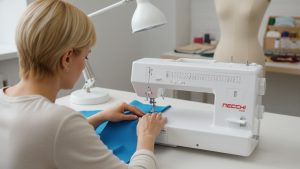
If a passion for sewing runs in your family—passed down to you by your mother or grandmother—it’s a good idea to ask someone who knows how to sew for advice on buying a sewing machine. And don’t forget to ask about an intensive sewing course, too: learning from someone who is already experienced will make things much easier!
You don’t need an embroidery machine or a serger to get started: for hems, repairs, and simple sewing projects, a basic mechanical or electronic home sewing machine is all you need.
Easy-to-read controls, a clear manual, and simple bobbin preparation are verifiable criteria for ease of use—helpful factors to consider when navigating a selection of sewing machines for beginners.
Not all users are the same: some are looking for a machine to get some practice—being beginners—while others need a professional model for work-related use.
When you are looking for the perfect model for your needs, this factor determines the approximate budget and the type of model you should lean toward.
Essentially, it is a good idea to list the five types of sewing tasks you perform most often, noting the fabric, number of layers, type of stitch, and frequency for each. For simple garments and mending, a few basic functions will suffice; for patchwork and creative projects, a precise zigzag stitch and a wide stitch width are recommended.
For bags and jackets, a robust motor and a presser foot with adjustable pressure are essential; for professional use, Sewshop recommends a heavy-duty machine capable of at least 1,000 stitches per minute and equipped with specialized presser feet.
Available space also influences your choice: for a small desk, a compact mechanical sewing machine is preferable. Conversely, for bulky items or quilting, an extension table is useful; for large-scale projects, you should check the amount of space to the right of the needle. The Brother sewing machine buying guide also recommends a large workspace or an extension table for quilting, along with a dual-feed system to handle multiple layers of fabric.
Regardless of the type of user, there are certain essential features to look for when buying a good sewing machine. The machine should be:

The difference comes down to these adjustments: tension balances the upper and lower threads, while presser foot pressure should be kept low for silk and high for leather.
If the fabric does not advance, you should check the feed dogs, the presser foot, and the stitch length—checks that are also described in the sewing machine troubleshooting guide.
Furthermore, when required by applicable regulations, the CE marking must be checked alongside the manufacturer’s details and safety instructions; however, it does not certify quality or durability. The European framework for the safety of consumer products—which applies from December 13, 2024, and includes online sales where relevant—is established by Regulation (EU) 2023/988.
This aspect should be considered not so much with the goal of saving as much as possible, but rather to place the model you are interested in within a specific quality tier. A model that is too inexpensive will likely prove unsatisfactory in terms of performance.
Models that are too cheap also tend to lack durability, meaning the savings won't actually be significant; if you're a beginner, it's advisable to invest at least 200-250 euros.
For quality home sewing, a mechanical machine typically costs between €300 and €400; models in the €400 to €800 range offer more features, while mechanical machines priced above €800 provide performance designed for intensive and/or semi-professional use.
The total cost also includes needles, bobbins, additional presser feet, and more; it is worth checking which accessories are included.
There are both mechanical and electronic sewing machines:
If you don’t have overly complex requirements—or if you are a beginner looking for a comprehensive, high-quality machine—you will find an electronic model to be an excellent choice. Features such as Start/Stop, speed control, and needle Up/Down positioning make your work much easier; keep these in mind as you compare different models in our catalog of electronic sewing machines.
If, on the other hand, you are already familiar with sewing machines or have reservations about computerized models, you should opt for a mechanical model—perhaps one of the more comprehensive and functional ones.
Here, cams control stitch movements without the use of an electronic circuit board—a solution well-suited for demanding tasks and intensive use, which you can find in our catalog of mechanical sewing machines. The number of stitches alone is no indicator of reliability or precision.
From home-use to professional models, at SewShop you’ll find machines that have been tested and come with a warranty of up to 5 years. Explore our catalog and sew with confidence.
For beginners, a standard home sewing machine with a straight stitch, zigzag stitch, needle threader, and adjustable thread tension is sufficient. A mechanical model is helpful for learning, as it requires manual adjustments, while an electronic model is a better choice if you prefer a more comprehensive and intuitive machine. It is best to start by practicing with straight and zigzag stitches, then move on to buttonholes and decorative stitching.
It depends on your experience and intended use. Mechanical models offer manual adjustments and are suitable for demanding tasks—even in mid-range versions—while electronic models provide preset stitch patterns and, depending on the specific model, may include features like Start/Stop and speed control. Stitch quality does not depend on the display; what truly matters is the fabric feed system, thread tension, and the combination of needle, thread, and fabric.
For beginners, it is advisable to invest at least €200–€250. A quality mechanical sewing machine for home use costs between €300 and €400; mechanical models with more features range from €400 to €800, while machines priced above €800 offer performance suitable for intensive use. In addition to the purchase price, you should also account for the cost of needles, presser feet, and maintenance.


