
No products in the cart.
Understanding why a sewing machine skips stitches and how to fix the problem is the first step toward getting back to uninterrupted sewing. The most common causes relate to the needle, threading, cleanliness, and the thread itself.
Skipped stitches always have a specific cause: an unsuitable or damaged needle, incorrect threading, accumulated dust, or poor-quality thread. Identifying the problem reduces troubleshooting time and protects the machine from further damage. For preventive maintenance, SewShop offers a sewing machine maintenance guide.
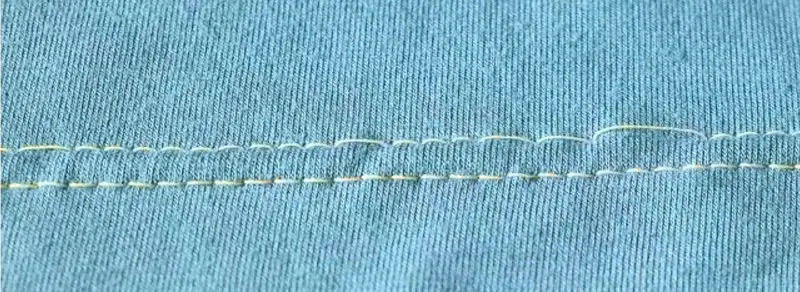
When a sewing machine skips stitches, it is best to replace the needle, even if it appears intact. It could be blunt, bent, or deformed without showing visible signs of damage. As it descends toward the hook, a damaged needle fails to properly catch the bobbin thread. Also, ensure that the flat side of the shank faces the back of the machine and that the needle is inserted fully into its seat.
A sewing machine producing uneven stitches often indicates a mismatch between the needle and the fabric. The key factors are the size and the shape of the point: they must suit the structure of the fabric you are sewing. A needle that is too fine will deform when used on thick material, whereas one that is too thick will damage lightweight fabric.
If you frequently work with denim, jeans, and heavy-duty fabrics, Schmetz jeans needles designed to prevent skipped stitches offer a reliable technical solution. The reinforced shank minimizes needle deflection under stress and reduces the risk of skipped stitches on home sewing machines. They are available in packs of 5 premium-quality needles, in sizes 100, 110, and assorted.
| Fabric type | Recommended needle | Recommended size |
| Chiffon, voile | Fine universal needle | 70/10 – 75/11 |
| Cotton, linen | Universal needle | 80/12 – 90/14 |
| Denim, jeans | Jeans needle (reinforced shank) | 90/14 – 100/16 |
| Fine knit fabric, Lycra | Stretch needle | 75/11 – 90/14 |
| Leather, vinyl | Leather needle | 90/14 – 100/16 |
Incorrect upper threading is one of the most common causes of skipped or irregular stitches. Re-threading the machine with the presser foot raised allows the thread to seat correctly between the tension discs. If the thread slips out of the discs, tension becomes unstable, preventing the stitch from forming properly. Low-quality thread causes knots and friction that can jam the sewing process.
If the tension is too high, the seam puckers; if it is too low, it remains loose and slack. Adjust it gradually and test each setting on a fabric scrap until you achieve a balanced stitch on both sides.
Thread residue and dust accumulate under the needle plate, in the bobbin area, and between the tension discs, hindering thread flow and the synchronization between the needle and the hook. Cleaning the machine every 8–10 hours of sewing effectively limits such buildup. Unplug the machine before removing the needle plate and use a small brush to reach hard-to-access areas.
Also clean the space between the upper thread tension discs; fiber residue gradually alters the pressure on the thread. Using a cover when the machine is not in use reduces dust accumulation and extends the intervals between cleanings.
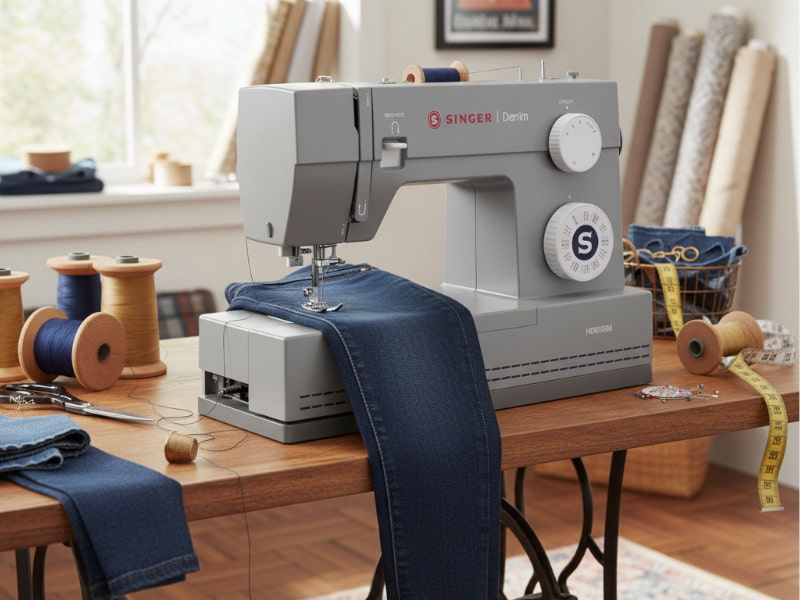
If the previous checks do not resolve the issue, a final manual test can help determine whether you need to consult a technician. Lower the needle by a couple of millimeters and turn the handwheel through a full rotation. This allows you to check if the needle is striking the hook or if there is a mechanical misalignment that cannot be fixed on your own. SewShop’s in-house technical workshop, staffed by specialists in major brands, can handle these types of mechanical issues. If the machine is used for many hours a day, consider a mechanical model from the durable mechanical sewing machines catalog; these require fewer adjustments and handle continuous use better.
A sewing machine that breaks the thread or skips stitches—despite using the right needle and correct threading—often has an internal mechanical issue. Addressing the problem early prevents damage to the needle plate or bobbin case, components that are more expensive to replace than a simple stretch needle or a spool of quality thread.
When working with heavy fabrics like denim, the needle encounters greater resistance. A standard needle may bend during its downward stroke and fail to properly catch the bobbin thread. It is best to use a specialized needle with a reinforced shank—in sizes 90/14 or 100/16—when working on jeans. Schmetz jeans needles, available at SewShop in packs of five (Extra quality), are designed to withstand this stress and minimize the issue of skipped stitches.
If the stitching looks uneven on the underside of the fabric, the top thread has likely not been threaded correctly. Re-threading the machine with the presser foot raised often solves the problem. If, however, the stitch appears unbalanced on both sides, the issue is the tension: adjust it gradually and test each setting on a scrap piece of fabric. The top thread and the bobbin thread must be of the same type.
Needles wear out even when there is no visible damage. As a general rule, it is best to replace the needle every 8–10 hours of sewing or at the start of a major new project. Replace it immediately if it has struck a button, zipper, or pin; the tip can become deformed without the damage being obvious, leading to skipped stitches, fraying, and problems with the needle plate.


