
No products in the cart.
This is a brief summary of the history of the sewing machine, certainly not exhaustive but hopefully interesting enough to learn about this invention that has revolutionized sewing since the 1800s.
The first patent in July 1755 relating to something resembling a sewing machine just so happens to be due to the German ‘Karl Friedrich Wiesenthal‘, who, with a double-pointed needle with a central eye, experimented with a sewing system just ahead of hand sewing.
Changing his approach completely in 1790 the English Thomas Saint fine-tuned a prototype preserved at the Victoria and Albert Museum in London that performed, however, only a chain-stitch seam.
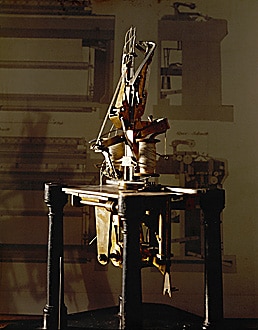
In England and Germany, objects are made for sewing, not sewing machines as we understand them, but the primogeniture of Europe is beyond question including several solutions still found in today's sewing machines.
Confirming this and we arrived in about 1810, a Viennese tailor put an end to the Anglo-German duopoly, and in 1814 Joseph Madersperger was honored by the Austrian emperor for this invention, fortunately the only example of this machine is preserved in the ‘Technishes Museum’ in Vienna.
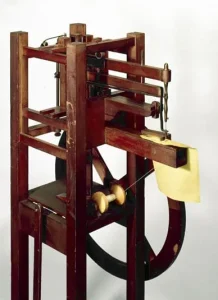
The first sewing machine to have practical use was invented by Barthélemy Thimonnier, a French tailor, in 1829.
His machine (made of wood) sewed a chain stitch like Saint's model, and in 1830, he contracted with Auguste Ferrand, a mining engineer, who made the necessary drawings and applied for a patent.
The patent for his machine was approved in July 1830, and in the same year, he started the world's first clothing manufacturing company with 80 sewing machines.
The plant was set on fire by industry workers afraid of losing their jobs. Fortunately, a specimen of the machine is on display at the ‘London Science Museum’.
The first lockstitch sewing machine was invented by Walter Hunt in 1832 but he soon lost interest in his invention and did not bother to patent it.

Sewing Machine by Elias Howe
The first machine to take advantage of all the inventions of the previous half century of innovation in the modern sewing machine was the device devised by English inventor John Fisher in 1844, which was built by Isaac Merritt Singer and Elias Howe in later years.
However, due to a mix-up made in filing Fisher's invention with the Patent Office, he did not receive proper recognition for the modern sewing machine in the legal disputes between the two Americans.
Based on all these experiences small companies were mass-producing such machines, but it was in 1851 that a name already mentioned and recognized as the pioneer of sewing machines, Isaac Merrit Singer, born in Pittstown in upstate New York, the son of a baker who had emigrated from Germany (and here we are in Europe again) with a penchant for mechanics, designed the first sewing machine with an arm parallel to the work surface, with a spring system that held the fabric in place under the needle while working, doesn't that sound like something we are still familiar with today?

The continuation of this invention was the treadle machine that many people are familiar with, and after about 30 years Singer, marketing of the first model with an electric motor begins.
At the same time in Europe Michael Pfaff abandoned the production of wind instruments and devoted himself to the production, on his own patent, of sewing machines. We have to wait until 1890 to find in Germany the first sewing machine with an oscillating shuttle, of which you can see a very well-preserved specimen roughly from the early 1900s, this machine was a great success.
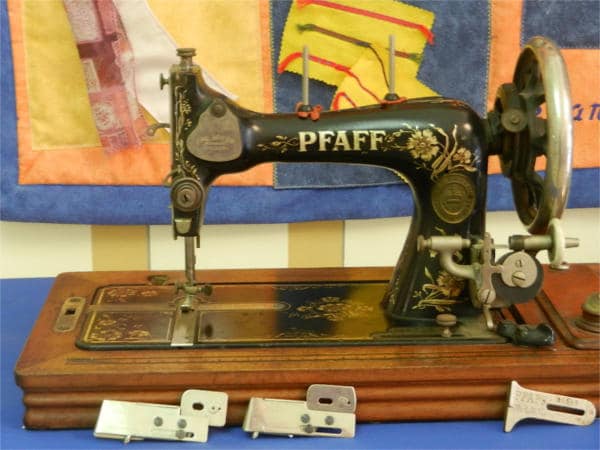
Various refinements and patents around the world led to different construction solutions, even dividing the various sewing machine companies in their choices.
In 1975 Singer produced the world's first electronic sewing machine (Athena 2000 in Italy called Futura 2000) and innovations were not lacking but all in the vein of the early pioneers.
Italian sewing machines
In Italy, the first industry to produce a sewing machine was Filotecnica Salmoiraghi in 1877. This brand distinguished itself until the closure of sewing machine production by the extreme quality of its products and the many inventions adopted in the construction of the various models.
As an example, she was the first to introduce the automatic buttonholer in a sewing machine.
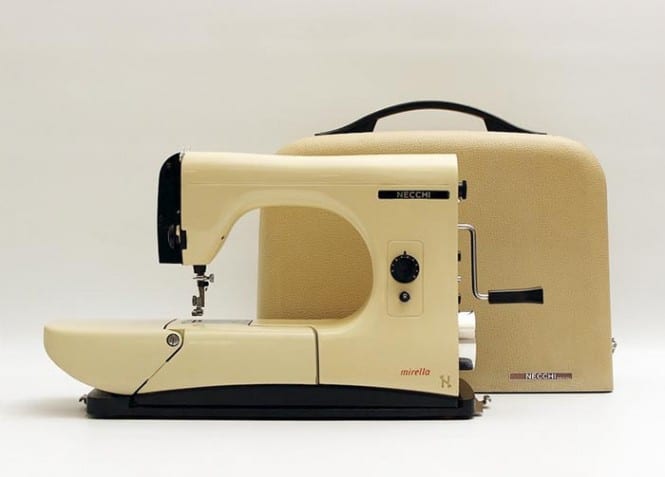
The best-known Italian brand still active in the sewing industry is undoubtedly Necchi. Vittorio Necchi at his wife's request for a sewing machine instead of buying it thought it best to manufacture a machine for domestic use using cast iron produced in the family foundries.
Thus began the adventure into the world of sewing with the 1st model called “BD” and then with the legendary “BU” a 1939 zig-zag capable of doing embroidery, the historic “BF” and in 1950 the “Supernova” machine still at the forefront of many findings today.
In 1956 the “Mirella” in addition to various awards entered the MOMA in New York as the highest recognition of its design. Also in Pavia was born the Vigorelli and in Milan the Borletti ‘perfect points’.
Of course we do not pretend that this article is the definitive ‘history’ of the invention of the sewing machine, that is not our intent and would not be possible, just take it as a starting point for further study.
Comments and additions are always welcome.


