
No products in the cart.
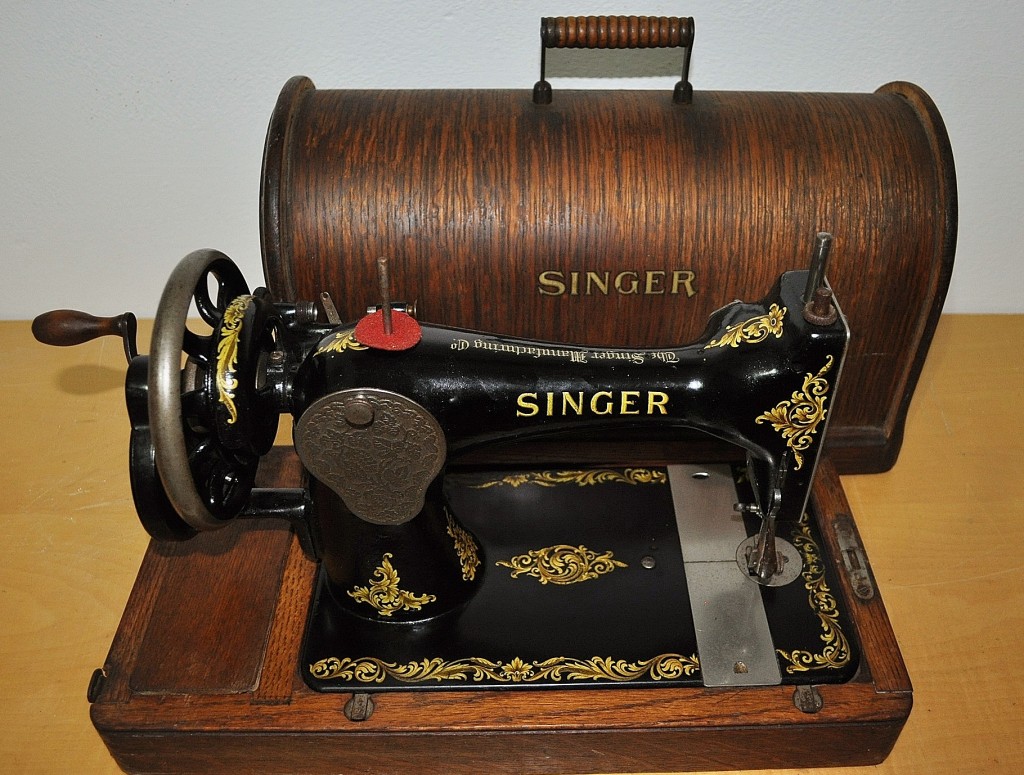 The history of Singer sewing machines Is more than 150 years long.
In the following articles we will outline the main stages that have led this remarkable invention to become a benchmark for sewing professionals and enthusiasts.
The first Singer sewing machine was born following 11 days of work and an investment of about $40. This prototype consisted of a straight needle and a cross shuttle, a presser foot that held the fabric in place so that it would not be pulled by the motion of the needle.
The structure provided a plane on which to rest the garment being processed, featured a suspended arm, a plane on which to rest the garment being processed, and a wheel aimed at transporting the fabric. The driving force of the entire mechanism was based on the use of a pedal similar to that used for spinning wheels.
Having obtained a patent for the first machine, Isaac Singer himself founded the company with his partner in Edward C. Clark, a New York lawyer.
In 1853, a factory was opened in New York and the Singer sewing machines produced there were sold for about $100.
Two years after the Singer could already claim to be the world's most important industry in the sector. The production chain also began to relocate abroad, specifically to Glasgow, Scotland.
After this initial phase of industrial expansion, the Company concentrated its resources in the area of developing machines for domestic use: in 1858 the first “Grasshopper” model was born, which would bring excellent benefits in terms of sales.
Three more production plants would later be opened in New York City, and sales expanded to South American markets as well. In 1861 foreign sales even exceeded those of the domestic market.
Le Singer sewing machines for home use gave the company excellent profits, so that from 20,000 units sold in 1863 to 180,000 in 1871. During this period the company's policy was aimed at decentralizing production to foreign countries, examples of which are the plants that sprang up in Glasgow and later Brighton, England.
The death of Isaac Merrit Singer at the age of 63 determines the handover of leadership of the industrial giant of Singer sewing machines Of fellow partner Edward Clark. The latter will be particularly active in spreading the Singer brand beyond U.S. borders.
In 1880 the Singer toccano le 500.000 unità di vendita, vengono inaugurati nuovi centri di produzione in Canada, Austria e Scozia. L’espansione dell’azienda è in piena ascesa, nei primissimi anni del 1900 Singer poteva già dirsi la principale produttrice di macchine da cucire al mondo, con una quota di mercato che si aggirava intorno all’80%. Sulla scorta di questi numeri la produzione di Singer sewing machines also arrived in 1902 in Russia, with the opening of the Podolsk ’plant.
With the advent of electricity the Singer sewing machine is enriched with new technological solutions that increase its functionality and effectiveness, leading to a real revolution in this field. The first experiments in this regard begin in the late 1800s, the first true electric sewing machine is in fact dated 1889 while it is from ’91 the first Singer electric sewing machine for domestic use. To understand the scope of the development that invested this company in the early 1900s it is possible to mention the construction in 1908 of the Singer Building at 149 Broadway, then among the tallest skyscrapers in the world, which remained Singer's headquarters until the 1960s.
With the advent of the world wars, the production of Singer sewing machines si bloccò così come la maggior parte dei mercati internazionali. Un ulteriore momento di difficoltà si ebbe durante il crollo della borsa americana nel 1929, nonostante l’acquisizione della Standard Sewing Machine Company, a cui seguì la massima espansione produttiva con ben 9 impianti di in tutto il mondo.
During World War II, the production of Singer sewing machines came to a complete halt as the company aimed to secure government contracts for weapons production. In this case, the suspension of production was due to the War production Board's regulations, which forcibly stopped factories that used copper, steel, iron or aluminum for civilian machinery. After the war years, production of the Singer resumed even more strongly, so much so that in the centennial year of its founding the company reached $307.8 million in revenues, a figure that would rise to $507 million after World War II.
After the 1950s, the American giant will begin to adopt a corporate policy aimed at diversifying the Singer sewing machines, which would be followed by the acquisitions of major companies of the time such as Packard Bell Electronics in 1966 and General Precision Equipment Corporation in 1968. At this stage, the goal was to extend its business to office machines and industrial control equipment as well. In 1963 the Singer Manufacturing Company becomes The Singer Company, e tre anni dopo viene raggiunto per la prima volta il miliardo di dollari di ricavo annuale. Per tutti gli anni ’70 i numeri dell’azienda continueranno a salire, nel 1975 nasce the first Singer sewing machine elettronica della storia, la Athena 2000. A partire da questa data la produzione sarà orientata prevalentemente verso modelli elettronici che negli anni ’80 attesteranno su livelli di performances davvero rivoluzionari. Ad oggi la production of Singer machines offre modelli sempre più sofisticati dal punto di vista tecnologico in grado di automatizzare la maggior parte dei processi. Attualmente la Singer rientra un gruppo finanziario denominato SVP Worldwide con sede ad Hamilton, Bermuda. Fonte: Wikipedia.org


